How to Choose the Right Home Tutor in Singapore: A Parent’s Guide
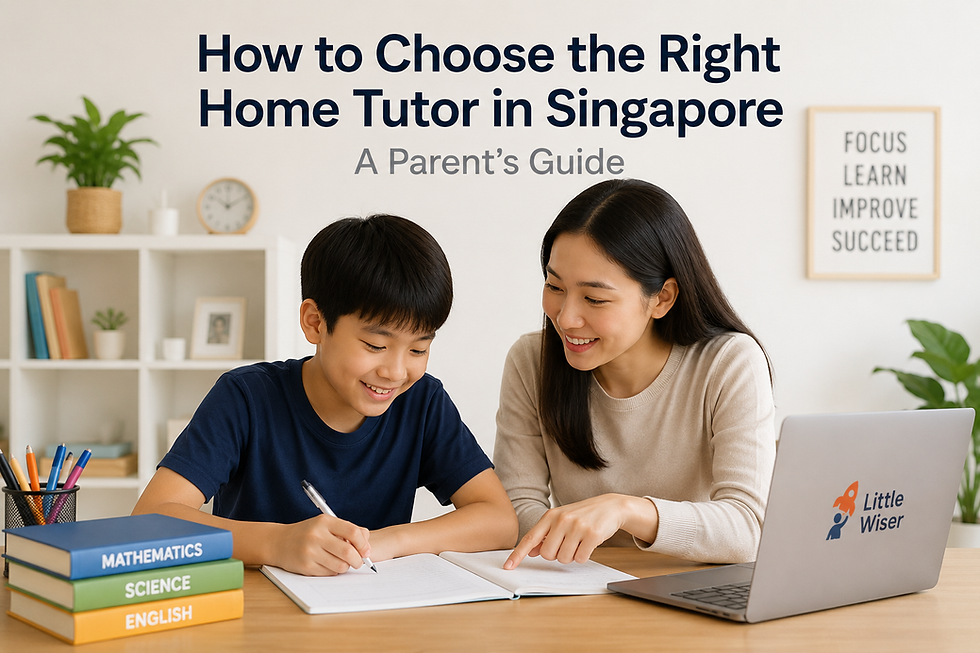
Choosing the right home tutor can help students build confidence, strengthen foundations, and achieve their academic goals.
How to Choose the Right Home Tutor in Singapore
Finding the right home tutor in Singapore can feel overwhelming, especially with so many options available. Some parents look for a private tutor to help their child catch up, while others want extra guidance for PSLE, O-Level, IP, JC, polytechnic, or university subjects.
The best tutor is not always the most expensive or the most academically impressive.
The right tutor is someone who understands the student’s learning needs, explains concepts clearly, and helps them build confidence over time.
1. Understand Your Child’s Learning Needs First
Before looking for a tutor, identify what your child really needs help with. Some students need to strengthen their basics, while others need exam-focused practice.
For example, a primary school student may need help building confidence in Mathematics or English. A secondary school student may need clearer explanations for E-Math, A-Math, Chemistry, or Physics. A JC student may need a tutor with strong subject mastery for H1 or H2 Mathematics, Chemistry, Economics, or General Paper.
Parents should consider:
Which subject is the weakest
Whether the issue is concepts, practice, confidence, or exam technique
Whether the student learns better with structured guidance or flexible coaching
Whether the goal is catching up, improving grades, or scoring higher distinctions
This helps you avoid choosing a tutor based only on qualifications.
2. Choose the Right Type of Tutor
In Singapore, parents usually choose between part-time tutors, full-time tutors, and MOE-trained tutors.
Part-time tutors are often university students or graduates. They may be suitable for students who need affordable and relatable academic support.
Full-time tutors usually have more teaching experience and structured lesson methods. They may be suitable for students preparing for major exams or those who need consistent long-term support.
MOE-trained or ex-MOE tutors may be preferred by parents who want someone familiar with the Singapore school system, syllabus expectations, and exam requirements.
There is no single “best” category. The best choice depends on your child’s level, subject, personality, and budget.
3. Look for Clear Teaching Style, Not Just Results
A tutor’s academic results matter, but teaching ability matters even more. A tutor who scored well may not automatically know how to explain difficult topics simply.
A good home tutor should be able to:
Break down concepts into simple steps
Identify weak areas quickly
Adjust lessons based on the student’s pace
Provide guided practice before independent work
Encourage the student without making them feel discouraged
For students who lack confidence, patience and communication are especially important.
4. Check Experience With the Correct Level and Subject
A tutor may be strong in Math but not familiar with every syllabus. For example, teaching Primary Math is very different from teaching A-Math or H2 Math.
Parents should check whether the tutor has experience with:
The student’s current level
The exact subject needed
The relevant exam format
Similar student profiles, such as weak foundations or high-achieving students aiming for distinctions
This is especially important for PSLE, O-Level, IP, JC, polytechnic, and university tuition.
5. Compare Tuition Rates Realistically
Home tuition rates in Singapore vary depending on the student’s level, subject, and tutor experience. Competitor rate guides commonly show that part-time tutors are usually the most affordable, while full-time and MOE-trained tutors charge higher rates due to experience and specialization.
Instead of choosing only based on the lowest rate, parents should ask whether the tutor’s teaching style and experience match the student’s needs. A slightly higher rate may be worthwhile if the tutor can explain better, provide structure, and help the student improve more consistently.
6. Ask the Right Questions Before Confirming
Before starting lessons, parents can ask:
What levels and subjects have you taught before?
How do you usually structure lessons?
How do you identify and address weak areas?
Do you provide homework or progress updates?
How do you help students prepare for exams?
Have you taught students with similar learning needs?
These questions help you understand whether the tutor is a good fit beyond just the profile.
7. Consider Personality Fit
A strong tutor-student fit can make lessons more effective. Some students need a patient and nurturing tutor, while others do better with a firm and structured tutor.
For younger students, the tutor should be encouraging and able to hold attention. For older students, subject mastery, exam strategy, and efficient explanations may matter more.
A good tutor should make the student feel comfortable asking questions, especially when they do not understand.
8. Decide Between Home Tuition and Online Tuition
Both home tuition and online tuition can work well.
Home tuition is often better for younger students, students who get distracted easily, or parents who prefer face-to-face guidance.
Online tuition can be more convenient for busy students, older learners, or families who prefer flexible scheduling.
The best format depends on the student’s attention span, learning habits, and subject requirements.
9. Use a Reliable Tuition Matching Process
A good tuition agency should not simply assign any available tutor. Proper matching should consider:
Student level
Subject
Budget
Preferred lesson mode
Location
Tutor experience
Learning needs
Parent preferences
At LittleWiser, parents can request tutors based on their child’s needs, preferred level, and subject requirements, helping make the matching process more personalised.
10. Watch Out for Red Flags
Parents should be careful if a tutor:
Cannot explain their teaching approach clearly
Refuses to share relevant qualifications when requested
Frequently changes lesson timings
Overpromises guaranteed results
Does not adapt to the student’s pace
Has poor communication with parents
Good tutors are professional, responsive, and honest about what improvement requires.
Final Thoughts
Choosing the right home tutor in Singapore is about more than finding someone with good grades. The best tutor should match the student’s learning needs, subject level, personality, and academic goals.
Whether your child needs help with PSLE tuition, secondary tuition, IP tuition, JC tuition, polytechnic tuition, or university tuition, the right tutor can make learning clearer, less stressful, and more effective.
At LittleWiser, we help parents find suitable tutors across different levels and subjects, including part-time, full-time, and MOE-trained tutors.
Looking for a tutor? Submit a tutor request and let LittleWiser help you find a suitable match.



Comments